Showing posts with label Alpha 1 Antitrypsin Deficiency. Show all posts

Friday, July 15, 2022

Good News for Alpha's

 A lot of people will see the headlines and think it's a great thing that another treatment has been found, and perhaps speculate on the pharmaceutical financial motivations for creating another drug. But for anyone with Alpha 1 Antitrypsin Deficiency, this is BIG news!  I, and others like me, have suffered greatly from the effects of a mutated gene.  For me it meant lung function decline, cirrhosis, kidney failure, heart failure and encephalopathy.  I was one of the lucky ones.  I got a new liver.  Although the process was long, grueling and filled with hurdles, I made it to the other side. Many don't.  AATD steals years from mothers, fathers, grandparents, siblings. To us, this news is HUGE!

Saint Louis University and Industry Partners Discover Treatment for Rare, Genetic Liver Disease


I'm looking forward to the day when no one has to go through what I've gone through the past 15 years of my life.  I was sick throughout my late 30's and my 40's.  This year I celebrated 50 and am feeling better than I imagined I could ever feel again. I'm beyond grateful!  But... I hope none of my children or grandchildren have to experience what I have, so yeah! for a treatment/cure.

 
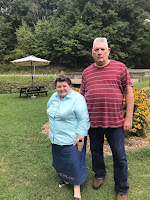
2020

2022

Almost two years post-transplant and thankful for every new day!


Wednesday, December 22, 2021

Rocky Road to Recovery

 After my transplant was fnally complete, I could hardly recognize myself.  I was unbelievably swollen.  My abdomen was huge.  It was like someone had put a huge tortoise shell on top of me.  My legs felt like they belonged to someone else.  But the thing that stood out most to me was my arms and shoulders.  They hurt horribly... worse than the incision from transplant.  My bones felt like they were burned.  The fingers on my right hand buzzed. (In transplant they insert IV's into very deep veins and can damage nerves in the process.) I begged for heating pads for my shoulders.  The wonderful nurses scoured the nearby wards for them for me.  

I want to shout out to the nurses.  Over the years, I've dealt with many.  Out of the hundreds of nurses I met over the years, I only had two bad experiences.  I've come in contact with a lot of great nurses, but those in the ICU units at Cleveland amazed me.  They were extremely knowledgable and skilled, but they were also compassionate and gracious.  They cleaned me, fed me, cheered me up... did everything I was unable to do during those first weeks.  I was very grateful for their assistance and care in my helpless state.

I was in the ICU nearly three weeks.  Most liver transplant patients are heading home at three weeks, so I had a pretty rocky start.  My goal was to get to the regular floor.  In order to do that, I had to be able to have my NG tube removed.  My nurse warned me not to push it.  "You'll really wish you hadn't if your stomach isn't ready."  I got it out soon after, and headed to the regular floor.

I was so happy to be on the regular floor!  It meant I was improving and thinking about heading home.  Little did I know, home was not in my immediate future.  My stomach began to fulfill the nurses dire warning.  An NG tube had to be reinserted.  I struggled with a bout of supraventricular tachycardia (rapid heart rate that required cardioversion - medically stopping and restarting the heart).  Once again I developed a pneumothorax and had to have a chest tube for more than a weak.  

My incision would bleed profusely.  At one point I was sitting up and looked down.  There was a four foot diameter pool of blood that was running from my chair to under my bed.  I freaked out, thinking I was bleeding to death.  The nurse called for help when she saw it.  It turned out to be blood laced water, which appeared more severe than it was.  

In the ICU, I had one-on-one care.  On the regular floor, I had great care, but lonliness began to set in as the nurses visited less and less often.  Additionally, the massive amounts of medication made me feel numb - like my personality was on mute.  The combination of the unresolved mental trauma from the shooting event in August and the crisis where my respiratory system shut down left me feeling vulnerable and unsafe.  As I struggled with bouts of dilerium, I hallucinated people trying to harm me and my son.  I became very withdrawn and started shutting people out.

I remember one day the surgeon came into my room like a whirlwind.  He opened the blinds and demanded to know why I was sitting in the dark.  Where was the Angela he knew?  This withdrawn, unsmiling person in the bed was unrecognizable!  He demanded to know what was wrong! I really didn't know what was wrong.

The next day, the hospital chaplain paid me a visit.  He was a really great guy, and I appreciated his concern.  We talked.  I enjoyed the visit.  Then they sent an art therapist.  I didn't know hospitals had such a thing.  But she sat my bed into a chair position and set me up to paint.  I finally did talk to her while I was painting and realized why I was feeling so down.  My mental health began to improve and I fought hard to recover.

My art therapy paintings...


Thursday, December 9, 2021

Face to Face with Death

September 1, 2020

Death is an adversary that each of will eventually lose to.  Regardless of our will to live and tenacity in the fight, death will one day win. Our best hope is to win a temporary battle.  Over the years of declining health, I felt pretty confident that with God's help I would win this particular battle with death.  As the days passed, I kept my bags packed and my cell phone charged and, in my hand, waiting for the call to say a liver was waiting and giving me an advantage in my struggle with death.  I truly believed it would come.  

When day seven came, my strength and hope began to fade.  At about 4:00 p.m. something inside of me began to die:  hope.  I was tired!  Even eating was exhausting.  I'd take one or two bites then need to nap.  Deep inside I knew that if I went to sleep one more time, that I wasn't going to wake up again.  And at that moment I desperately needed to go to sleep.

For a couple of minutes, I was angry with God.  I had believed he would bring me through.  I even said, "God, I don't understand. I trusted you. I couldn't treat my own kid this way."  But then I thought about eternity with Him and said, "I'm sorry I'm upset.  It's your right to call me home.  You created me.  I love you regardless.  If this is your will and my work on Earth is done, then so be it."  I closed my eyes and started to drift off.

Just then, the phone rang!  The words, "Angela, we have a liver for you," were like gasoline thrown on embers freshly snuffed out.  My hope erupted into a bonfire.  

I do want to say that there's something very sobering about coming face to face with your own limitations.  I think all of our lives we wonder how we would perform in certain scenarios. We want to believe that our courage, faith and strength would be up to the task.  The truth is that we have our limits.  II Corinthians 2:9 says that God's strength is made perfect in our weakness.  I believe that when I reached the end of my strength and faith God stepped in a carried me.  There's no way I would have survived what came next on my own.  

Tuesday, December 7, 2021

Changing the Odds

Drug addiction has taken a heavy toll on America.  When I see the obituaries of young lives snuffed out it breaks my heart.  I don't believe there can be any benefit in a young life needlessly lost, but there have been changes in the organ donation scenario because of it.  True, many addicts have Hepatitis C, which used to preclude them from donating organs.  That is no longer true.

When my liver function began to stabilize at around 32 MELD and my pulmonary pressure receded, the doctors approached me about accepting a liver with Hepatitis C.  During my initial approval, I had been given the choice.  At that time, I felt that if I were going to go through a liver transplant, I wanted a healthy liver.  But now, I just wanted to increase my chances of living.  The doctors explained that someone more likely to survive would get the available healthy livers instead of me, but if I would accept a Hepatitis C liver, I could double my odds.  I would be treated afterwards, and in 3 months I would be Hepatitis free.  I accepted.  

The negative of accepting an organ with Hepatitis C is the obvious:  you always carry the DNA for Hepatitis C.  Even though it's dormant after treatment, there is the possibility of reoccurrence.  The positive is that you increase your odds of getting an organ.  It's a personal choice each individual has to make for themselves.  

Once I agreed to the Hep C liver option, it was time to go back to the regular floor and focus on building my strength for the upcoming transplant.  They wanted me out of bed and walking as much as possible.  I hadn't walked in nearly a month.  I was so shocked at how difficult it was to walk.  My feet burned.  I needed assistance for a few days and used a walker, but I fought hard.

One day I was walking down the hall and asked the physical therapist if my glasses were dirty.  I could hardly see.  She looked puzzled and said they were not.  Later that day, things began to look stranger:  the ceiling tiles were straight on one end of the room and at a 45-degree angle on the other side, and people started having one set of eyes, but two mouths.  I didn't realize I was having another bout of hepatic encephalopathy.  

During that time, I posted false information on my Facebook page, and made videos that didn't make sense (we laugh at them now). Eventually I got too confused to answer my phone.  My family couldn't visit and now they couldn't talk to me.  Of course, they were concerned!  My mother moved heaven and earth and alerted the liver team that something was wrong and demanded an answer.  There's no advocate like a worried mother!

Eventually, the encephalopathy improved.  I was as stable as I would be, whether in the hospital or at home.  My hematologist visited me one morning and said that I had been the alternate to a transplant the night before (if something had not worked out for that person, it would have come to me).  He said he believed that within 7 days I would have a liver.  Could I keep fighting for 7 days longer?

A memory that makes me cry every time...

The nurse got me settled into my parents' car.  Dad started the car, paused, looked back at me and said, "I haven't felt like this since the day I brought you home from the hospital for the first time.  I'm so afraid something will go wrong while you're in my care."

When you're extremely ill, it's easy to forget that what you're going through affects everyone around you.  


August 2, 2021
Waiting


Sunday, December 5, 2021

Facing a Huge Setback

 I spent most of August in the Cleveland Clinic Hospital.  I started out on the regular floor, but as my MELD Score climbed to 36 and my condition deteriorated, the doctors believed I was bleeding internally and started blood transfusions. I recall a kind doctor sitting by my bed and asking me if it would be all right for them to move me to the ICU so they could do some tests more quickly.  I agreed.  Boy was I in for a shock!

There were two tests they needed to do right away:  an endoscopy and a colonoscopy.  What they didn't forewarn me was that because of my condition, they couldn't risk giving me anesthesia.  The probability that I'd go into a coma was too high.  I didn't want to risk losing my opportunity for a liver, so I agreed.  They did an endoscopy and colonoscopy bedside, with no medication or sedation. 

Let me tell you... I will never agree to that again in this lifetime.  It felt like someone was playing a violent game of racecars going over massive speedbumps at 100 mph inside of me.  I don't know if it was because I was so sick, or if it always feels like that, and that's why they give you sedatives to do the procedure.  Every procedure I had during that period was without sedatives.  It was honestly traumatic.  They couldn't find the source of any bleeding, regardless of the tests they ran.

I was too weak physically to resist or make a commotion.  I wanted to live badly enough that I probably wouldn't have fussed regardless.  In the quiet moments, I began to take in my surroundings The ICU had dividers and curtains, but no doors.  I could see the two people across from me and kitty corner.  Both of them were comatose and on life support.  I heard the emergency team intubate the man on the other side of the divider. I could literally feel death stalking the halls of that ward. I later learned that few people ever left that ICU unit.  Most patients died there.  The nurses lined the halls and cheered when I eventually left.  I refused to give in to fear of death. What flicker of life that was left in me fought to hold onto hope and believe that God would step in and everything would be okay.  

The next thing I knew, a doctor was apologizing that I had to be removed from the transplant list.  I was simply too sick and wouldn't survive surgery.  In that moment, I was devastated beyond words and filled with anger.  I was not going to accept what that doctor said!   I had been listening to my church's livestream feed and service was in progress.  I knew that when things are impossible, that God is the master of the impossible.  

I texted my son, who was in that church service.  I told him the news and wanted him to ask the church to pray for me.  He went to the platform and showed our pastor the text.  I saw him step to the pulpit and have the church go to immediate prayer for me.

If you've read the story in the bible where the lame man's friends tore the roof off a building to lower him down to Jusus... that's how I felt.  That's when my pastor, church, family and my friends began to carry me.  I honestly could feel the strength of all the prayers being lifted up for me.  


August 13, 2020

Dealing with being taken off the 

transplant list.

Side Note:  If you listen to the video, I talk about the difficulty of lifting my head.  I later found out that I was clipped to the bed with the dialysis cords - that's why I couldn't lift my head.  I laughed and laughed over that.  The humor was good medicine.  

Friday, December 3, 2021

Confusion Sets In

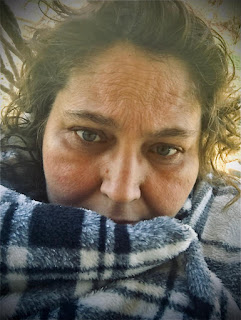
I found myself back in the hospital on August 3, 2020.  My MELD score had climbed to 28. My kidneys were again failing due to my Cirrhosis, and I was ballooning with fluid.  The doctors limited me to one liter of water per day.  I felt desperately thirsty and begged for more to drink.  At first, I joked around with the doctors, showing them these two pictures and saying my goal was to look young and healthy again, but this is what I would look like when they were done.  


We all laughed.  My humor about it held for a while.  At this point in the COVID pandemic, I could have one visitor who could come to see me, so my husband would come on the weekends.   When he would bring a drink that weekend, I would beg him for a sip.  He's not a rigid rule person, so he would say I could have a sip. Then I'd drink his whole drink and try to shake more from the bottle.  Then he stopped bringing his drinks to the room.  

About that time, I began to demonstrate signs of hepatic encephalopathy.  I was confused, I couldn't answer basic questions about the time, who was president, and general questions.  They even moved my room to outside the nurse's station, and I was totally unaware of the change.  I remember my husband sitting there talking to the doctor, then the doctor asking me to put my hands out in front of me. He looked at my husband and nodded.

I was unable to follow their conversation in my state, but I knew what the test was about.  If you have hepatic encephalopathy, when asked to put your hands in front of you with your palms forward, they will move backward and forward (flap).  In that moment, I knew that I had it, I was angry that they wouldn't give me more time to answer the questions (I wanted to prove them wrong), but I was unable to express my frustration.  I soon just fell asleep.  I was doing a lot of sleeping. Sleeping is part of the progression of death from Cirrhosis:  sleeping encephalopathy, coma, death.

After a few days, I began to come to my senses a bit.  The doctor explained that their attempt to limit my fluid too drastically had increased the ammonia levels in my brain, which caused my deterioration.  Once they brought my fluid levels to two liters of fluid per day, I was still pretty foggy, but I could communicate and understand what was happening around me.  

Thursday, December 2, 2021

July 4, 2020

 This post is hard for me to write.  I've started writing it three times... and broke down in tears remembering.  Even though this is the most emotionally painful moment in my life, it is also the source of the greatest gratitude of my life.  Every time I'm together with my kids and grandchildren this event makes those moments we share so much more precious!

The week of July 4th is our usual family vacation week.  In 2020 the kids came home.  By then I was too sick to travel.  I did my best to enjoy every minute, but I was so sick.  On July 4th we rented a pontoon boat to enjoy the afternoon on the lake.  I remember laying in the boat and just watching my family around me.  In my heart, I was crying.  By the end of the day, I was so sick I had to go the emergency room.  We were only 3 days into vacation.  The image of my kids and grandkids standing on the porch and waving goodbye is etched into my brain.  The reality that this moment could very well be the last I would ever see or hug them, and the last memory my grandbabies would have of me, hit me like a tsunami.  I was overwhelmed and emotionally crushed when we pulled out of the driveway that day.

My transplant coordinator had told me that I could go the UPMC facility emergency room, but if my MELD score was 22 or above, I needed to be transferred to Cleveland.  Once again, the medical team didn't understand MELD, but they did a wonderful job of catching up on it and contacting the transplant team.  I was taken to Cleveland via ambulance.  After a day or so, it became clear that I would not be going home to finish the vacation, so Anita and her family headed back to North Carolina.  Vacation was over.

At the hospital, they discovered that my kidneys were failing (Stage 3) and my heart was struggling because of the massive amount of fluid my body was retaining.  I was puzzled because I was taking diuretics and on a restricted fluid intake and following it closely.  One doctor explained that my red blood cells weren't able to retain their water and fluid was being distributed into all of my tissue.  I stayed for a week while they gave me dialysis and IV diuretics.  My fluid levels came down a bit and my kidney function stabilized.  I was thankful to be going home again.  


Ready to head home from the hospital in July 2020
with a bandage from dialysis.


Wednesday, December 1, 2021

My Support System

Along with my faith in God, my husband's sense of humor kept my spirits from staying down too terribly long.  I remember going to Sam's Club.  I asked him to drop me off at the door because I knew I couldn't walk across the distance of the parking lot.  I don't know why it embarrassed me, but using the electric carts always did - even though I knew I had no choice.  This particular time he walked through the door after parking the truck with his camera on and started videoing walking around me 360 degrees in the cart and describing the specs like he was a race commentator and I was just waiting for the shot to start.  He followed me into the store commenting on the turn radius and the power.  He was always egging me to make it beep when people blocked the aisle.  If I wouldn't, he would mimic the sound and pretend I did it. I couldn't help but laugh, relax and enjoy the ride.  

Did you know that if you don't have a person who will commit to being a 24 hour/day caregiver, you have very little chance of being listed for liver transplant?  My mother became my dedicated caregiver and legal guardian.  She and Dad would care for me around the clock in the months following transplant.  In the meantime I came to rely heavily on my daughter for moral support, my son to drive me to appointments, act as a nurse, grocery shop, menu plan and cook, while my husband kept the household afloat.

Outside of my immediate family, I also had a strong support network.  My minister, his wife and my church family held me up in prayer, brought meals, sent cards and words of encouragement.  My Facebook friends became a huge support.  At times I would be overwhelmed with gratitude to know how many people and entire churches across the country and around the world were praying specifically for me.  My coworkers were all rooting for me and encouraging me as well.  I felt humbled and loved to have so many people in my life who cared about me.

Throughout the first half of 2020, my strength diminished very quickly.  I stayed working as long as I could, but everything was getting foggy.  I realized I was having difficulty when I tried to create lecture videos.  My sentences were getting broken, pauses very long, and I didn't always hold to a train of thought.  I was putting files in the wrong folders on the computer and really struggling to focus.  By the end of February, I knew it was time to quit working and rest.  By May I had quit driving, getting groceries or going anyplace that didn't have an electric cart. Even then I'd often stay sitting in the truck when my husband went into stores.  I wanted to be out of the house in the sunshine, but that was even taxing on my strength.

The couch, my hammock swing and my hammock became my life. I didn't want to just give up, so I planted a container garden to give myself something small to do that was enjoyable - although to be honest, my son did most of the planting. I mostly watched the vegetables grow and watered them twice a week.  I watched tons of cooking and gardening videos online, I called and talked to my mom and my daughter nearly every day, and tried to do things daily that made me feel like I had accomplished something.  In time, my To Do list shrank to one thing, but I did give myself grace.  I knew how much effort that one thing took for me to accomplish.  


My Family Support System

Caregivers


Caregivers/Guardian:  Mom and Dad

Nurse and Helper:  Andrew

Inspiration:  Kaya, Noa and Isla (This is the photo I made my phone wallpaper to remind myself why I was fighting during the hard times... and to show off to all of the nurses and doctors. lol)

Spirit Elevator and Stabilizer:  Wayne

Medical Advisor and Spokesperson:  Anita


Tuesday, November 30, 2021

A Fighting Chance

 By fall of 2019, I had been with my specialist team for several years and was being seen on a monthly basis. My MELD score had crept up to over 15 (which is qualifying to be listed for transplant).  When I broached the subject of getting listed, I was told to wait until it hit 18 - then we would talk again.  I was getting edgy, but I thought the doctors were doing what was best for me.  So when I heard in no uncertain terms that there were no plans to put me on the transplant list, I had a choice:  be crushed or fight.  Once again, I became my own advocate for transplant.

MELD SCORE:  is calculated from lab tests for creatinine,  bilirubin and INR and ranges from 6 to 40 (6 is normal, 40 is.. well, dead for all intents and purposes).  It is use to predict your mortality rate for the next 3 months.  It is also used to calculate how often you need to see your doctor and have labs drawn.  

In October of 2019, I asked a coworker whose daughter was a doctor at the Cleveland Clinic liver transplant center to refer me to a good doctor.  I set up my appointment to be evaluated.  It's amazing that two doctors can have the same degree and background, yet one sees your situation as a possibility while the other an impossibility. This doctor believed I had a chance and scheduled me for the transplant evaluation.

While I was waiting to be listed for transplant, I can't count the number of times people asked when I would be listed.. as though it can just be a scheduled surgery.  There is so much involved in a transplant.  Before I saw the evaluation team, I had to have all of my dental work complete, have a dermatologist go over every bit of skin on my body to check for cancer, see my gynecologist... just to name a few.

In January 2020, I finally got to the evaluation... which is a full 5 days of back-to-back appointments!  I had to have a caregiver with me, meet with every kind of specialist you can imagine, had MRI's, CT scans, ultrasounds, x-rays, more bloodwork than I ever dreamed a person could donate (something like 30 vials).  In addition to physical criteria, you have to go through financial evaluation, behavioral health evaluation, nutritional evaluation, then a social worker helps you make a will and sign legal guardianship over to your caregiver.  It's a lot!  By the time it was over I was totally drained - physically and emotionally.

I was assigned a pre-transplant coordinator nurse, then had to wait.  If everyone agreed that I was a good candidate, then it would go to UNOS for a board approval.  After that....

APRIL 14, 2020 WAS A DAY FOR CELEBRATION!  

I WAS FINALLY ON THE TRANSPLANT LIST!

April 9, 2020
Tired and waiting

Monday, November 29, 2021

The Long, Slow Fade

I've always burned the candle at both ends, but the slow descent of my health from 2018 to 2019 left me with only one very small flickering flame.  Every few months I'd be in the hospital or emergency room.  I made constant trips to Pittsburgh specialists and had regular endoscopies and colonoscopies.  My body began to manifest the failure of my liver to do its job.  I developed:
  • Portal Hypertension (pressure in the vein the goes from the gastric region into the liver)
  • Splenomegaly (enlarged spleen)
  • Esophogeal varices (enlarged veins from the back up of pressure)
  • Fluid retention
  • Malnutrition
  • Bouts of supraventricular tachycardia requiring cardioversion (heart rate above 180 that doesn't resolve without the heart being stopped and restarted via either medication or electric paddles)
With all of things happening to me, the hardest thing for me to deal with was the tiredness.  There is a tiredness that has nothing to do with the lack of sleep.  It drains the life from you.  I still wanted to be in the thick of family and church gatherings, but I sat quietly and watched rather than participating.  At home I began breaking common tasks into small increments.  I learned to cope. Through it all, I continued to stay in good spirits, to hope and believe everything would be okay; but that dark cloud was getting closer and I couldn't just ignore it anymore.

In the fall of 2019, my brother-in-law passed away and was an organ donor.  My sister-in-law offered his liver to me if it was a match, so I called my doctors to find out the answer.  What I found out shocked me!  My doctor had no intention of putting me on a transplant list.  She thought my lungs would not hold up to a transplant.  I was devastated!

Me having a particularly hard day in 2018:
I kept my smile on and wore a lot of
really bright colors to stay positive


My First Crash

 My health held steady for most of 2016.  I had a few hospitalizations and bouts of pleurisy - very painful, but treatable with antibiotics and steroids.  Things changed early in 2017.  My liver function crashed in April.  I still don't totally understand why liver failure causes pleural effusion for me.  Most people struggle with ascites (fluid in the abdomen) instead.

Pleural Effusion is the buildup of fluid between the layer of pleura and the outside of the lungs. It causes the lungs to become compressed and breathing becomes difficult.  

When the layer of pleura becomes inflamed it is called Pleurisy.  Many describe the feeling of pleurisy as sandpaper rubbing again the outside of the lungs with each breath. 

Because I had reached crisis stage and was really struggling for breath, the doctor attempted to draw fluid from my side with a needle and then inserted a chest tube.  It was my husband's job to hold me still.  To say it was painful is an understatement.  My tough husband had to let go and sit down to keep from passing out.  It was rough!  Finally, the chest tube was inserted and I was transferred to Allegheny General Hospital in Pittsburgh.   

As the fluid drained from my chest, it continually refilled.  It wasn't working and I was in trouble! My right lung had collapsed as high as my shoulder blade and the left lung was on its heels.  At some point I had also developed a pneumothorax (air in the pleural cavity) in addition to everything else I was struggling with.  It did mend without surgery, thankfully.  With everything happening to me, I thought I would receive a transplant and get back on my feet.  My doctors said no.  They wanted to do a procedure call TIPS.

TIPS(Transjugular Intrahepatic Portosystemic Shunt):  the doctor enters the jugular vein in the right side of the neck, inserts a needle to tunnel through liver tissue then places a shunt in a hepatic vein.

I waited for 3 days for a specialist doctor to fly in to do the procedure.  It worked.  The fluid began to slow and the buildup finally drained.  But the crisis wasn't over.  I began to run and unexplained fever.  They discovered that I'd developed a blood clot in the medical port I'd had put in for my weekly Prolastin C infusions.  The port had to be removed before I could go home.  

For 7 months, I felt great!  The terrible pressure in my chest and abdomen had lessened, I had energy and hope that this could last a long time.  The doctor assured me that she had patients for whom it had worked for 10 years.  It made it to seven months for me. 

2017:  The hole from TIPS and a scar
from the Mediport removal (which was 
later replaced on the other side).

Sunday, November 28, 2021

Challenges of a Rare Disease

 Living with a rare disease can be unsettling.   In my case, I diagnosed my disease and took the results to my doctor, who then confirmed my diagnosis.  The problem comes when you have done a ton of research and your doctor studied Alpha 1 Antitrypsin Deficiency one semester in med school a long time ago, but has never dealt with it personally.  On many occasions when I was being treated in a doctor's office, emergency room or in the hospital, I had to explain the disease to the medical staff.  When one of them gives you off-the-cuff information and you've read the medical studies that refute the information, you feel pretty vulnerable and frustrated. I learned I had to be my own medical advocate early.  

My first experience with liver failure and doctor error occurred in the summer of 2015, I just didn't know that's what it was.  I was hospitalized for 3 days locally and asked the attending physician to make sure my liver was okay, because I knew Alpha 1 is a liver disease.  He didn't take it seriously; said I was overweight and had some fatty liver; then diagnosed me with gastroenteritis.

  Early in 2016, I was again severely ill with abdominal pain, right shoulder pain, vomiting, and shortness of breath, but this time I didn't waste energy on the local hospital.  I went to a UPMC facility, and the doctors there heard me.  Once again, no one really knew what Alpha 1 was, but they figured it out and sent me to a specialist.  After a biopsy and a month of waiting for the results to come back from analysis at the Mayo Clinic, my suspicions were confirmed.  I had Cirrhosis, Stage 4, caused by Alpha 1 Antitrypsin Deficiency.   The only cure would be a liver transplant... if my lungs could stay healthy enough and hold up to a transplant.  (I've since learned you can get both a liver and lungs, but that's the information I was given at the time.)

Did you know that when you are faced with terminal illness that you go through the same stages of grief (denial, anger, bargaining, depression and acceptance) that you do when you lose a loved one?  I did know that in the back of my mind, but I didn't apply it to myself for quite a long while.  Perhaps I was in denial.  Perhaps I had faith.  Perhaps it was a little of both.  I saw Cirrhosis as a black cloud on the horizon threatening to bring in a bad storm.  I kept my chin up, my back to the cloud and just kept right on with life... until I'd deal with a bad flare up and end up in the hospital.  Deep inside, I believed I would make it to transplant then everything would be fine.


2016:  I stayed pretty active, but developed a relationship with my hammock on sick days. 
Left:  Me in my hammock on Mother's Day
Right:  Climbing the rocks at Freedom Falls with my hubby on July 4th.


Saturday, November 27, 2021

I Thought I'd Won

I like to win... games, tests, arguments, life... whatever, whenever and however.  I like to win.  By Spring of 2016 I thought I was the winner in my battle with Alpha 1 Antitrypsin.   At diagnosis, my first of many Pulmonary Function Tests showed my FEV1 to be 52%, but a year later it had risen to 68%.  Everyone was surprised!

A PFT involves sitting inside a glass booth and breathing into a tube.  The test measures how well your lungs exchange oxygen and carbon dioxide as well as how much oxygen you can inhale and exhale (the short version).  FEV1 is the reading that tells how your lungs compare to the expected function of someone your height, weight and age.

Prolastin C only makes the claim to stop the progression of the disease.  It makes no claims to improve lung function, so when my lung function improved that much, I was ecstatic. 

I knew that viruses were lethal to my health and took steps to avoid sick people, but I had one more hurdle to get over... pollutants.  One early summer night I left the bedroom window open.  The air smelled great, and I enjoy the sound of the creek flowing near my house.  I did not know that the neighbors would start a bonfire after I went to bed, or that the smoke would enter my window.  Breathing the trace smoke from that bonfire caused me to have a respiratory illness that took 6 weeks to recover from. I learned that my doctors' warning to stay away from any kind of smoke or pollutant was vital to my wellbeing.  

I had a three-pronged plan to win my fight with Alpha 1:  stop progression of the disease with Prolastin C Infusions, stay away from people who were ill with a virus, and stay away from air pollutants.  It worked!  My respiratory infections decreased drastically.  I really thought I had won... I felt like a champion!
 

Me teaching at LTI
Feeling like a winner


Wednesday, November 24, 2021

The Beginning of a Long Journey

Today, I saw a picture of me .. a picture of me a year ago.  Feelings of gratitude and thankfulness swept over me as I pulled a grandbaby close for a snuggle.  That woman had faith.  That woman had hope.  Today, this woman has the joy of living in the warmth of what was once just sparks of faith and hope.


If you ask me to define my miracle, I will say that I'm alive - but that doesn't begin to tell of the many miracles that kept me alive.  I tend to live in the moment, enjoy the gift of each day to its fullest, and try not to dwell on the hardships of getting here.  Lately, flashes have been popping into my mind.  Maybe it's time to talk about some of these experiences.

Sometimes when I try to remember, I just can't seem to breathe.  The memories merge into a feeling of panic and I pull away.  But today, I will find one memory to face.  Perhaps I should start at the beginning.

Pre-Diagnosis

It was January 2009.  I shivered with fever and cold as I lay underneath my mobile home with a hairdryer attempting to thaw frozen pipes.  It was my first winter as a single mom.  I knew to plug the heat tape in when winter came, but I didn't know there was a light that indicated whether or not the heat tape was working.  When my pipes froze, my 102 + fever didn't have a say in what needed to be done.  I couldn't afford to replace cracked pipes, so I had to fix the problem immediately.  So there I was... racked with coughing, burning up with fever... laying under my mobile home in snow at below 0 temperatures.

That winter seemed to be horrific for viruses at Sunset Heights Christian Academy.  The students continuously brought in viruses and I had pneumonia five times that school year.  I fractured ribs and separated my sternum coughing.  I even managed to get whooping cough in addition.  I didn't know what was happening to my body, but I knew something was wrong, seriously wrong.

I struggled with bouts of pneumonia and sickness for five more years.  My doctor thought maybe it was lupus, but it didn't fully add up.  My inflammation markers were always extremely high, other labs were inconsistent as well.  Finally, in 2015 one of my mother's doctors who was treating her asthma-like symptoms suggest an Alpha 1 Antitrypsin Deficiency test (though he thought it was highly unlikely).  

Alpha 1 Antitrypsin Deficiency is a hereditary disorder.  It lives in the liver and mutates the protein enzymes that produce Antitrypsin, which protects the bodies organs.  The organ most impacted by low levels of Antitrypsin is the lungs.  Alpha's often suffer from COPD and/or Emphysema without having smoked.  It usually presents in the patient's 50's.  Additionally, the liver can become damaged by the mutated proteins and Cirrhosis develops.  While this occurs later in life in some patients, most patients experience liver symptoms from Alpha 1 in the first two years of life.

Mom tested positive as a carrier.  She had 1 mutated gene and 1 normal gene.  I immediately went to AlphaNet.com and ordered my own free test.  It made sense!  All the years of suffering suddenly might have a name.  While I waited for results, I researched.  What I found was not good news, but there was a treatment.  That meant hope.

It was May 2015 (I don't remember the exact date)  I graduated with my Masters Degree, celebrated, then came home.  I remember my heart beat seemed to pause for a second when I saw the letter in the mailbox.  My diagnosis was Alpha1 Antitrypsin Deficiency ZZ (which meant my father had to be a carrier too).  My Antitrypsin level was 4  - normal is around 100.  I finally knew why I had been struggling, but I had no idea the journey I was setting out on.  

In the Shadow of the Mustard Tree

I found this journal entry I wrote in the early 2000's as I sat on the hill outside the church I had grown up in, my father pastored and...